
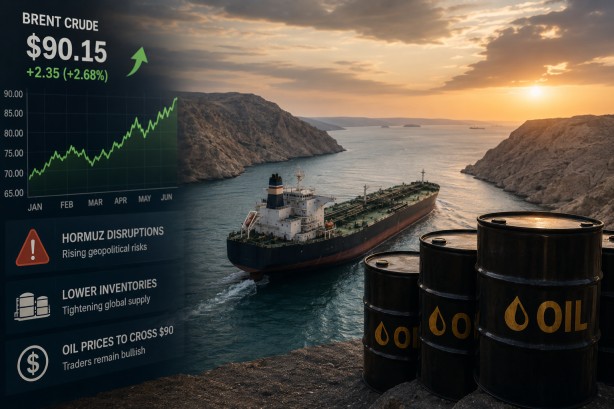
Oil prices have surged significantly this week, marking their most substantial increase since April. However, energy analysts suggest that Brent crude will need either a prolonged disruption in the Strait of Hormuz or definitive signs of tightening global supplies to push past the $90 per barrel threshold. As of Friday, Brent crude was trading close to $85 after an 11% weekly gain, while West Texas Intermediate, the U.S. benchmark, neared $80. The price climb has been attributed to renewed tensions between the U.S. and Iran, impacting Middle Eastern supply channels and reducing tanker activity through the critical Strait of Hormuz.
Despite these rising tensions, Brent crude has struggled to surmount this week’s peak of $87.55 per barrel. Market analysts indicate that traders are still banking on diplomatic solutions to forestall a prolonged crisis. The Strait of Hormuz remains a pivotal concern for global energy markets, as approximately 20% of the world’s oil supply transits this strategic waterway. Shipping companies are on high alert, closely monitoring the security situation due to a slowdown in tanker movements.
The effects of these developments are already rippling through fuel markets. In the United States, refining margins have increased as diesel and gasoline supplies face tightening constraints. Similarly, European fuel markets are experiencing mounting pressure. Additional complications from disruptions to Russian exports have further fueled worries about global supply stability.
According to analysts, a decisive move above $90 per barrel for oil prices seems unlikely unless there is a significant reduction in inventories or an escalation in tensions between Washington and Tehran, which could lead to a more extended disruption of shipping through the Strait of Hormuz. For now, traders are keenly observing diplomatic progress and supply data to gauge the next major shift in global oil markets.