
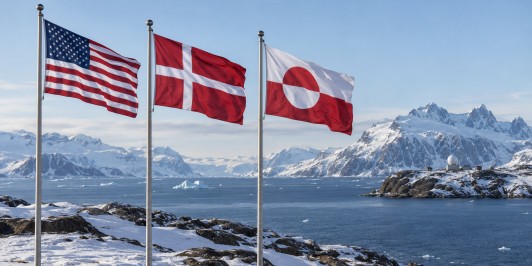
The United States, Denmark, and Greenland have formalized a trilateral agreement to enhance security cooperation in the Arctic and North Atlantic regions. Signed during the United Nations General Assembly in New York, this accord allows the U.S. to expand its military presence in Greenland without altering its sovereignty.
The agreement permits the U.S. to establish new defense zones at Narsarsuaq and Mestersvig and to develop a “Golden Dome” missile defense system. This marks a significant amendment to the 1951 U.S.-Denmark defense agreement, broadening U.S. access to Greenland’s airspace and territorial waters while preventing non-NATO military establishments on the island.
Greenland, a self-governing territory within the Kingdom of Denmark, remains under Danish sovereignty according to the pact, which also acknowledges Greenland’s right to self-determination. However, before the agreement takes effect, it requires approval through Denmark’s and Greenland’s parliamentary procedures.
This development follows a period of tensions after U.S. President Donald Trump expressed interest in acquiring Greenland due to its strategic location between North America and Europe and its rich mineral resources. While such a transfer of control is not part of the agreement, the pact does allow for a broader U.S. military footprint, the most substantial since the Cold War, complementing the existing Pituffik Space Base operated by the U.S. in northwestern Greenland.
Additionally, the agreement imposes restrictions on foreign investment in critical sectors, including infrastructure and resource extraction, aiming to safeguard the region from non-NATO influences. This strategic move underscores the geopolitical importance of Greenland in Arctic security dynamics.