
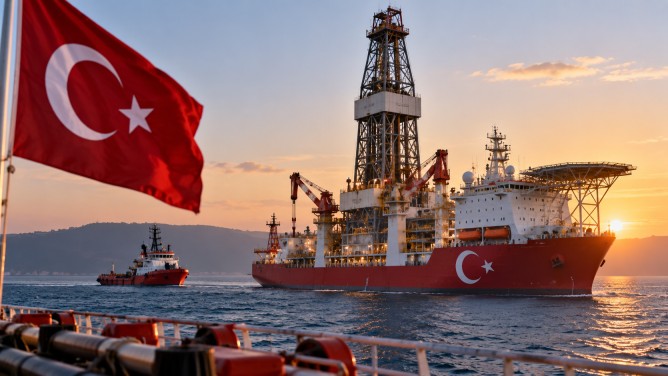
Türkiye is set to embark on a technically demanding oil drilling project in the western Black Sea, as part of a broader initiative to bolster its domestic oil and natural gas reserves. Energy Minister Alparslan Bayraktar announced the forthcoming operation, noting the complexities involved and the potentially lengthy timeline. The nation has outlined plans to drill six exploratory wells across various sectors of the Black Sea by 2026, reflecting its increased focus on offshore exploration.
In recent years, Türkiye has significantly enhanced its offshore capabilities, now boasting a fleet of six deep-water drilling vessels. Several of these are actively engaged in both exploration and development tasks in the Black Sea region. This expansion aligns with Türkiye’s broader energy strategy, which emphasizes reducing reliance on imported energy resources and enhancing self-sufficiency through domestic production.
A pivotal component of this strategy is the substantial increase in gas production from the Black Sea fields. Türkiye aims to double its output by the close of this year, capitalizing on the estimated 785 billion cubic meters of gas reserves identified since 2020. Currently, the production stands at approximately 9.5 million cubic meters per day, meeting the energy needs of around 4 million households. Projections suggest that annual production could escalate to between 16 and 17 billion cubic meters by 2028.
Beyond augmenting gas production, Türkiye is also investing in expanding its LNG infrastructure and enhancing pipeline networks. These efforts are part of a concerted push to establish the country as a key energy transit hub in the region. As part of this vision, Türkiye is exploring various potential routes to channel gas from the Middle East into European markets, thus solidifying its strategic role in the energy sector.